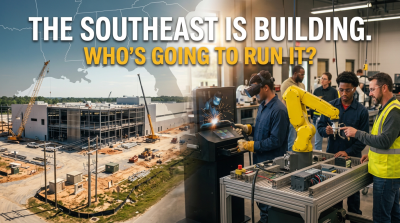
Part 1 of ‘Built Here’—a comprehensive series investigating how the Southeast is undergoing an unprecedented construction boom, and taking a closer look at the innovative training equipment, grants, and labs equipping workers to run these critical facilities.
In the rural northeast corner of Louisiana, Meta is building one of the largest data centers in the world. On the Mississippi coast, Ingalls Shipbuilding is putting new welders through a virtual reality lab faster than it could train them on steel alone. Along Alabama’s Gulf Coast, a new federal grant is preparing hundreds of adults for jobs in welding, pipefitting and machining.
These are three very different projects in three states. The problem they face is the same: the jobs are arriving faster than the people trained to do them.
This series looks at that gap. It covers what the Southeast is building, which skills those projects need, where training for those skills actually happens, and what schools and colleges can do about it before the next funding cycle closes.
What is the Southeast building?
Here are three projects that show the scale.
Data centers. Meta’s Richland Parish, Louisiana campus represents more than $50 billion in investment, according to the company. It will take more than 7,500 construction workers at peak and about 1,000 permanent operations staff once it’s running. Most of that construction workforce is electrical, mechanical and HVAC. A data center is, at its core, a building full of power distribution and cooling.
Shipyards. Ingalls Shipbuilding in Pascagoula, Mississippi opened a virtual reality welding lab in January 2025. By September 2026 more than 1,000 trainees had been through it, and the company says the simulators give trainees up to ten times more practice than traditional methods alone. Ingalls built the lab with the U.S. Navy, AccelerateMS and Mississippi Gulf Coast Community College.
The trades behind it all. In September, a $4 million U.S. Department of Labor grant launched on Alabama’s Gulf Coast to train 550 adults in Mobile and Baldwin counties over 42 months. The trades it covers are welding, pipefitting, shipfitting, electrical, machining and advanced manufacturing.
Nationally, the numbers point the same way. The Manufacturing Institute and Deloitte estimate that U.S. manufacturers could need as many as 3.8 million new workers between 2024 and 2033, and that 1.9 million of those jobs could go unfilled if the skills gap isn’t addressed. Associated Builders and Contractors estimates the construction industry needs to bring in 349,000 net new workers in 2026 alone.
Which jobs are hardest to fill?
The jobs these projects need aren’t new. What’s changed is how many are needed at once, and in the same places. Across plants, shipyards and data centers, the same handful of skills keep coming up:
- Welders and pipefitters. Ships, plants, pipelines, and the structural steel and piping inside data centers all depend on them.
- Electricians. Every new facility needs them to build it and to keep it running.
- HVAC and mechanical technicians. Cooling is a core system in a data center, not a comfort feature.
- Industrial maintenance technicians. These are the people who keep motors, PLCs, hydraulics and conveyors running once a plant opens.
- Robotics and automation technicians. More lines run on robots, and each robot needs someone who can program it, troubleshoot it and get it running again.
None of these is an entry-level job you can learn on day one. Each one takes months or years of hands-on practice.
Why can’t these skills be learned from a textbook?
A student can read about welding. They can’t learn to weld until they’ve run hundreds of beads and seen what went wrong with each one. The same goes for troubleshooting a PLC, charging an HVAC system, or finding out why a robot is putting a part half an inch off.
That’s why Ingalls’ ten-times-more-practice figure matters. The skill comes from repetition with feedback, and training programs only get that if they have enough equipment, enough stations, and enough time on each one.
It’s also why these jobs start in a lab: a high school CTE program, a technical college shop, or an employer’s training center. The plant or shipyard can finish the training, but it can’t start from zero.
Where is the money for training coming from?
The good news for schools and colleges is that states across the Southeast are funding this directly. A few examples:
- Alabama committed $250 million to expanding and modernizing career tech over 2025 and 2026, including a new CTE Facilities Grant for regional centers.
- Tennessee’s school funding formula sent about $281 million directly to CTE in 2025–26.
- Mississippi’s EquipMS grants pay for equipment in high school CTE programs tied to in-demand jobs.
- Georgia opened a new Office of Education and Workforce Strategy in July 2026 to coordinate education and workforce planning statewide.
Federal Perkins V funding goes out to every state each year, and equipment is an allowable use. Employers are part of it too: the Manufacturing Institute found that 73% of manufacturers partner with technical colleges to build their talent pipeline.
What decides whether the training actually works?
Funding and new buildings are the visible part. What decides whether a graduate can walk onto a job site ready to work is what’s inside the lab:
- Does the equipment match the jobs? A welding program preparing students for shipyard work needs different processes and positions than one focused on light fabrication. A program preparing students for critical facilities needs electrical and HVAC trainers that reflect current systems.
- Are there enough stations? Practice time is the whole game. One trainer shared by twenty students doesn’t produce twenty technicians.
- Can instructors run it? Equipment that sits unused because no one was trained on it is a common way funding gets wasted.
- Can every student reach it? Many of these projects are in rural counties, and rural districts often have the fewest labs. Some are solving this with mobile labs that rotate between schools.
Most of these decisions get made long before the equipment arrives, when someone is writing a grant application and deciding what to ask for. For labs opening in fall 2027, that writing is happening this winter.
What’s next in this series
- What critical facilities need from your electrical and HVAC program. Coming in November
- Who teaches the next welder? The instructor gap in CTE. Coming in December
How TTA fits in
Technical Training Aids has supplied training equipment, software and curriculum to schools, colleges and employers across the Southeast since 1963. We represent manufacturers across welding, HVAC/R, advanced manufacturing, CNC and robotics, EV and more, and we build mobile training labs for districts that need to bring the lab to the students.
Frequently asked questions
Which jobs are in highest demand in the Southeast right now?
Across the region’s plants, shipyards and data center projects, the skills that come up most are welding and pipefitting, electrical, HVAC and mechanical, industrial maintenance, and robotics and automation.
How are CTE programs in the Southeast funded?
Most programs combine federal Perkins V funds, state CTE funding (which each state structures differently), competitive state grants such as Alabama’s CTE Facilities Grant and Mississippi’s EquipMS, and employer partnerships.
When should a school start planning a new training lab?
Earlier than most people expect. The equipment list is usually set when the grant application is written, often six to twelve months before installation. For labs opening in fall 2027, planning should be under way this winter.
What is a mobile training lab?
A mobile training lab is a trailer fitted out as a working lab, with equipment for pathways such as advanced manufacturing or construction trades. It rotates between schools, so one investment can reach students across a whole district.
How do I find out more?
Get the rest of the series in your inbox. Subscribe to the TTA newsletter!
If you’re planning a lab, or writing an application for one, we’re glad to help you work out what to ask for. Reach out to our team today!